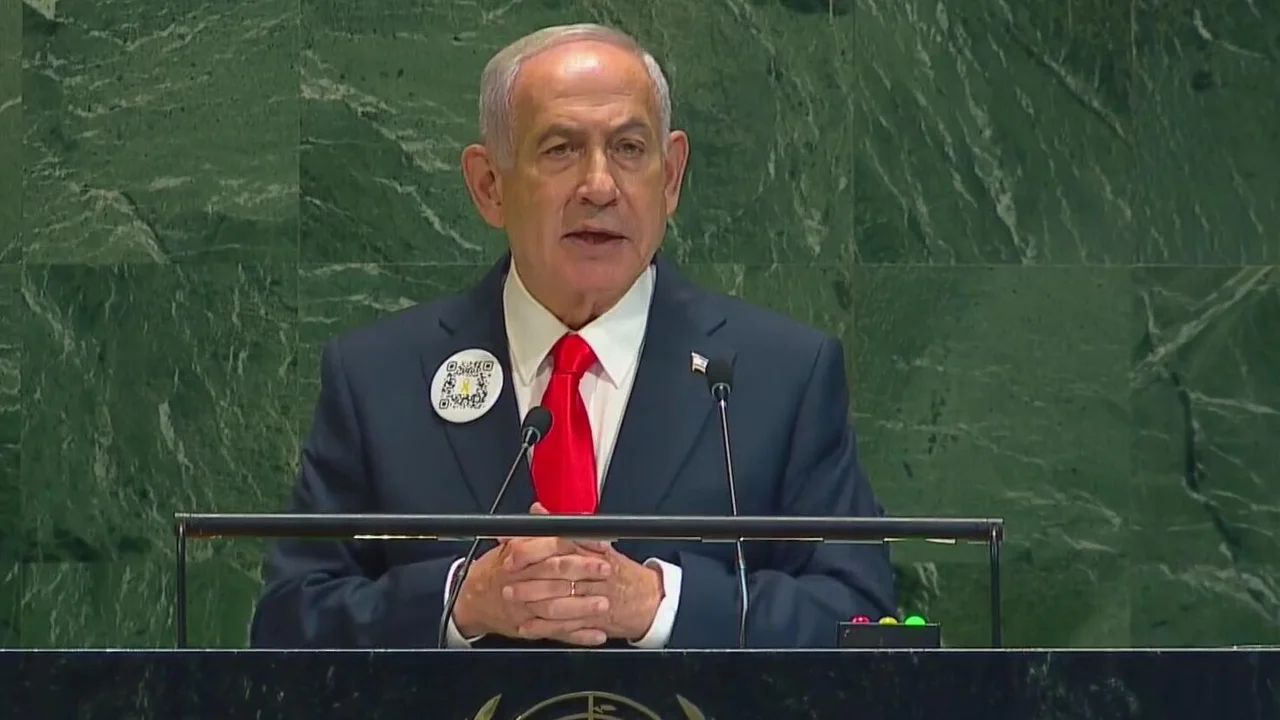
NGOCSTIP – Netanyahu took the stage at the United Nations General Assembly with a defiant posture, vowing that “Israel must finish the job” in Gaza. The room had already been thinned by walkouts as delegates exited when his speech began. Deepening Israel’s isolation, he used the stage to lash out at Western nations recognizing Palestinian statehood, accusing them of encouraging terrorism and accusing critics of moral weakness. His delivery was sharp, his visuals bold, and his message clear: despite mounting pressure, his government will not relent. Moments earlier, protestors had marched outside the UN in New York demanding accountability and justice for Gaza. Inside, the empty seats and hushed murmurs bore witness to a moment of diplomatic rupture.
Netanyahu’s address did not go uninterrupted. As he began to speak, more than a score of delegations left the hall in protest. The departures punctuated the controversy around his presence and policies. Some diplomats described their walkout as a moral imperative in response to the language and framing he planned to use. Netanyahu, undeterred, continued his speech to a diminished audience, aware that his remarks would attract global attention regardless of the sparse attendance. The symbolic stripping of legitimacy was on full display, and the walkouts served as both protest and statement. The empty seats spoke louder than applause in many corners.
“Read about: Shocking End: Assata Shakur Dies at 78 in Cuba After Decades on the Run!”
During his UN address, Netanyahu rejected accusations of genocide and dismissed claims that Israel is deliberately starving civilians in Gaza. The ongoing conflict, according to him, represents a seven-front war spanning Gaza, Iran, Syria, Lebanon, and other regional threats. As part of his visual presentation, a large map labeled THE CURSE was used to emphasize his arguments. Western countries that recently recognized Palestinian statehood were sharply criticized, with Netanyahu calling such moves disgraceful and dangerous.
In contrast to global hesitation, he stressed that Israel remains resolute under pressure. He also mentioned the hostages still held in Gaza and gave assurances that the government will keep working to bring them home. He laid out clear conditions for Hamas, demanding that they disarm and release the captives or face continued consequences. His office claimed that the speech reached Gaza through loudspeakers and mobile phone broadcasts, although no one has independently confirmed this.
“Read more: Trump Sounds the Alarm: Tylenol Might Not Be Safe for Kids, He Warns!”
The diplomatic fallout was immediate. Outside the UN, thousands marched in New York, carrying signs demanding liberation for Palestinians and decrying what they saw as impunity. Protesters chanted that Netanyahu was a war criminal and not welcome in the city. In parallel, many world leaders refused to engage; some reduced their delegations or sent lower‑ranking officials. Israel’s critics accused him of using the UN as a platform for propaganda rather than diplomacy. Domestically, opposition voices described the address as redundant and lacking a peace plan or pathway for hostages. Within the UN, diplomats assessed whether additional sanctions or measures could follow. The walkouts and protests became part of the narrative: not just a speech, but a moment of political rupture.
Netanyahu’s vow to “finish the job” signals that Israel plans to press its military operations aggressively, likely in Gaza City’s remaining enclaves. His framing seeks to normalize long wars under the guise of existential defense. But the risks are substantial: humanitarian collapse, diplomatic isolation, and further legal scrutiny under international law. Recognition of Palestinian statehood by Western nations challenges Israel’s claim to unilateral dominance. Meanwhile, the hostages’ plight, the suffering in Gaza, and mounting international pressure place Israel at a crossroads. The UN address may mark a turning point in this war’s narrative, as global attention intensifies and legitimacy is contested not just on the battlefield but in diplomacy, courtrooms, and public opinion.
This article is sourced from www.aljazeera.com and for more details you can read at ngocstip
Writer: Sarah Azhari
Editor: Anisa
NGOCSTIP - Lembaga swadaya masyarakat di seluruh Indonesia kini mengimplementasikan jaringan pemantauan berbasis data yang mencatat 12.4% peningkatan kasus perdagangan…
NGOCSTIP - Organisasi sipil mempercepat pemulihan korban bencana lewat program dukungan mental dan ekonomi, menurut data Badan Nasional Penanggulangan Bencana…
NGOCSTIP - Data Kemenkumham 2023 mencatat lebih dari 412.000 organisasi masyarakat sipil terdaftar di Indonesia. Namun, realitas lapangan menunjukkan kurang…
NGOCSTIP - Tantangan demokrasi dan keterbatasan sumber daya memaksa lembaga swadaya masyarakat untuk bertransformasi secara drastis. Tidak lagi sekadar demonstrasi…
NGOCSTIP - Data Komnas Perempuan mencatat sebanyak 299.511 kasus kekerasan seksual terjadi selama periode 2015 hingga 2023 di Indonesia. Angka…
NGOCSTIP - Laporan Edelman Trust Barometer 2023 menunjukkan anomali menarik di tengah krisis kepercayaan global terhadap institusi formal. Kepercayaan terhadap…